
Why a Thermomix Gets More Useful in Midlife
I came to Thermomix late.
Two years ago, to be exact. Which means I spent the better part of my forties and early fifties cooking everything the long way — including the years I was working out what my body needed through perimenopause and out the other side. The years when I was most invested in getting food right, and least able to spare the time and energy to do it properly.
I wish I'd had it sooner. Not because it's a shortcut, but because it removes the specific kind of friction that makes good eating fall apart in midlife — and I know exactly what that friction costs, because I paid it.
That's really why The Cook's Catalyst exists. I came out the other side with the knowledge. Sharing it so other women don't have to work quite as hard to get there seems like the obvious thing to do with it.
The problem with midlife nutrition isn't information
By the time most of us hit midlife, we know perfectly well what healthy eating looks like. We know protein matters. We know vegetables aren't optional. We know that the meal assembled from the supermarket chiller section — the one with a 14-day shelf life and an ingredient list that requires a chemistry background to interpret — is not quite the same as cooking from scratch.
We know all of this.
The problem is the Wednesday at 6:30pm when we're tired, the fridge looks uninspiring, and the supermarket premade or the Uber Eats app is right there. Convenient. Fast. Requiring zero decisions.
The problem is the gap between what we intend to eat and what we actually eat when life is running at full capacity.
That gap is where most midlife nutrition intentions quietly die.
What midlife actually demands from food
A few things shift in midlife that change what food needs to do.
Protein matters more than it used to — not as a trend, as a biological reality. Muscle becomes harder to maintain, the body becomes less efficient at using what it gets, and eating enough consistently starts to move the needle in ways it simply didn't at thirty-five.
Gut health is mostly built in the kitchen, not in the supplement aisle. More plants, more variety, more fibre, more fermented foods. Less complicated than it sounds, and more important than most people realise — particularly when mood, cognition and sleep are already in active negotiation.
And body composition in midlife is the conversation nobody is having honestly. It isn't simply a calories problem. Hormones, sleep and stress all matter. So does what we're repeatedly eating — whether meals are built around protein, plants and actual fibre, or around convenience food and its quietly destabilising blood sugar rollercoaster.
None of this is new information. What changes is how much effort it takes to execute when you're also managing a career, ageing parents, adult children, a relationship, and a mental load that doesn't lighten just because you'd like it to.
This is where the Thermomix earns its place — and then some
The machine doesn't change the nutritional science. What it changes is the practicality of acting on it — which, in midlife, is usually the actual problem. The nutritional targets get more demanding at exactly the same time life gets busier. That's where the machine earns its place on the bench twice over.
Protein-rich meals become faster to prepare and easier to repeat — and I don't mean soups and curries. That was my assumption for longer than I'd like to admit.
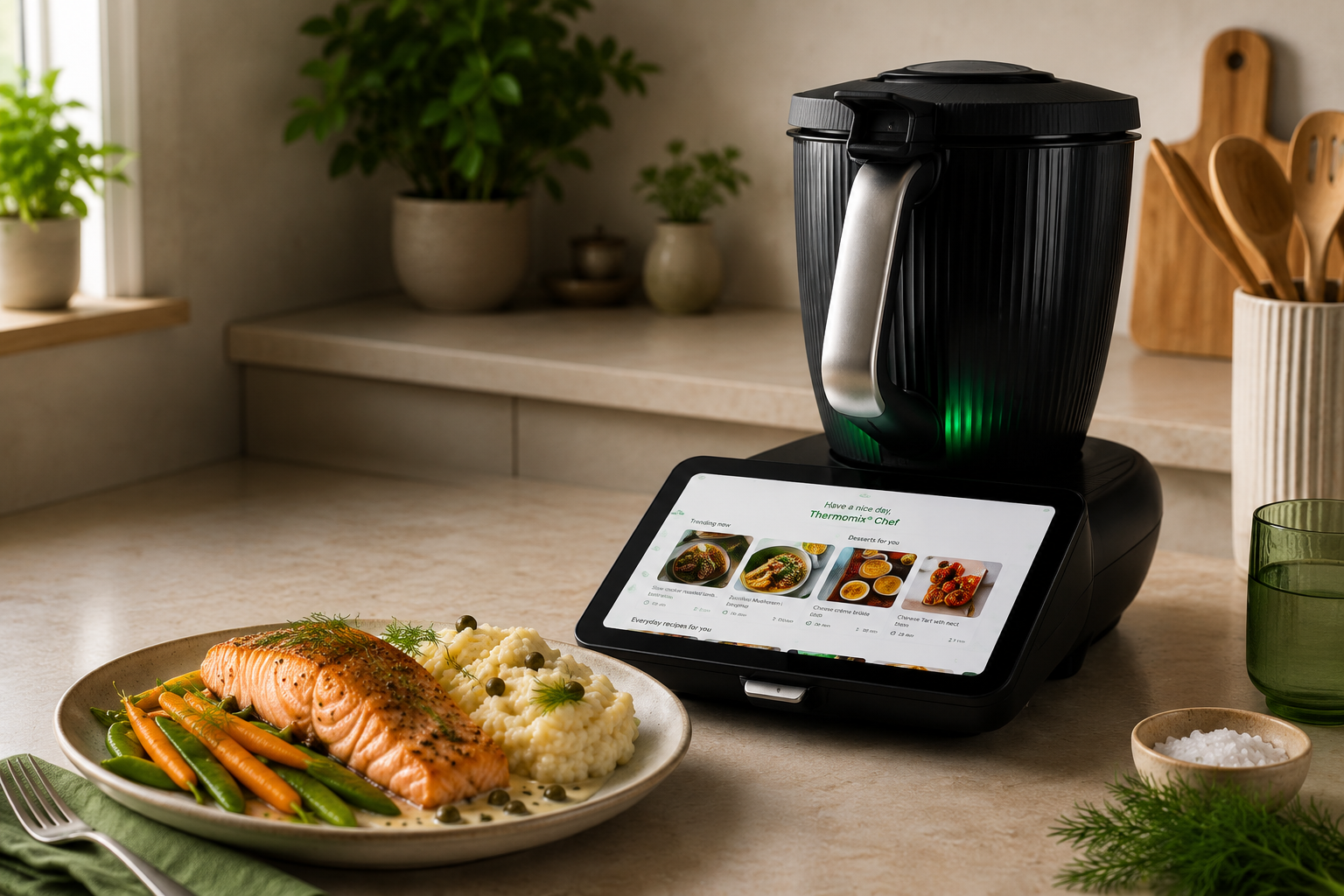
The reality in 2026 is considerably more interesting. Salmon fillets with baby carrots and sugar snap peas in the Varoma, mash and a mustard-caper velouté building in the bowl underneath from the cooking liquid. A complete dinner — protein, vegetables, sauce — produced in 50 minutes while you read to the kids, fold the laundry or sit down with a book.
This is not a soup machine. It’s a different proposition entirely.
The variety of plants that good gut health genuinely requires — beans, brassicas, wholegrains, the fermented things that belong on your regular rotation rather than in a health article you bookmarked and forgot — all become far less of a production.
One thing I've noticed is that Cookidoo nudges me towards more variety than I'd naturally create on my own. A week that includes a barley dish, a vegetable-rich soup and a bean recipe is doing considerably more for gut health than another supplement sitting in the pantry.
And instead of the supermarket premade with its preservatives, emulsifiers and the ingredient list that's more chemistry experiment than dinner, you have an actual meal. One you made. From food.
The benefit nobody talks about
Decision fatigue is real, and by midlife most of us have been deciding what to cook every single day for two-plus decades. The exhausting invisible loop of it: what are we having, do we have the ingredients, will anyone eat it, what's for lunch tomorrow.
The cooking itself is rarely the problem. The deciding is.
Saved recipes, meal planning, a Cookidoo library curated to your actual household — these remove a surprising amount of mental load. And that matters, because the more cognitive effort a meal requires, the less likely it is to happen when it needs to.
What I've actually taken from this
The older I get, the less interested I am in eating perfectly. I'm far more interested in building systems that make good decisions easier — meals satisfying enough to repeat, quick enough to happen on a busy night, and nutritionally solid enough to support what my body actually needs at this stage of life.
I got there eventually. I just had to do it the hard way for longer than necessary, without the tools or the roadmap.
The Thermomix is one part of the system I wish I'd had earlier. Not magic. Not a substitute for knowing what you're putting on the plate. But a genuinely useful machine that would have made the whole transition considerably easier — and I'd have arrived at this end of it in better shape than I did.
That's as honest an endorsement as a kitchen appliance is going to get from me.
P.S. Curious about what the TM7 specifically does that earlier models couldn't? It's all here.
