Do I Cut the Mustard?
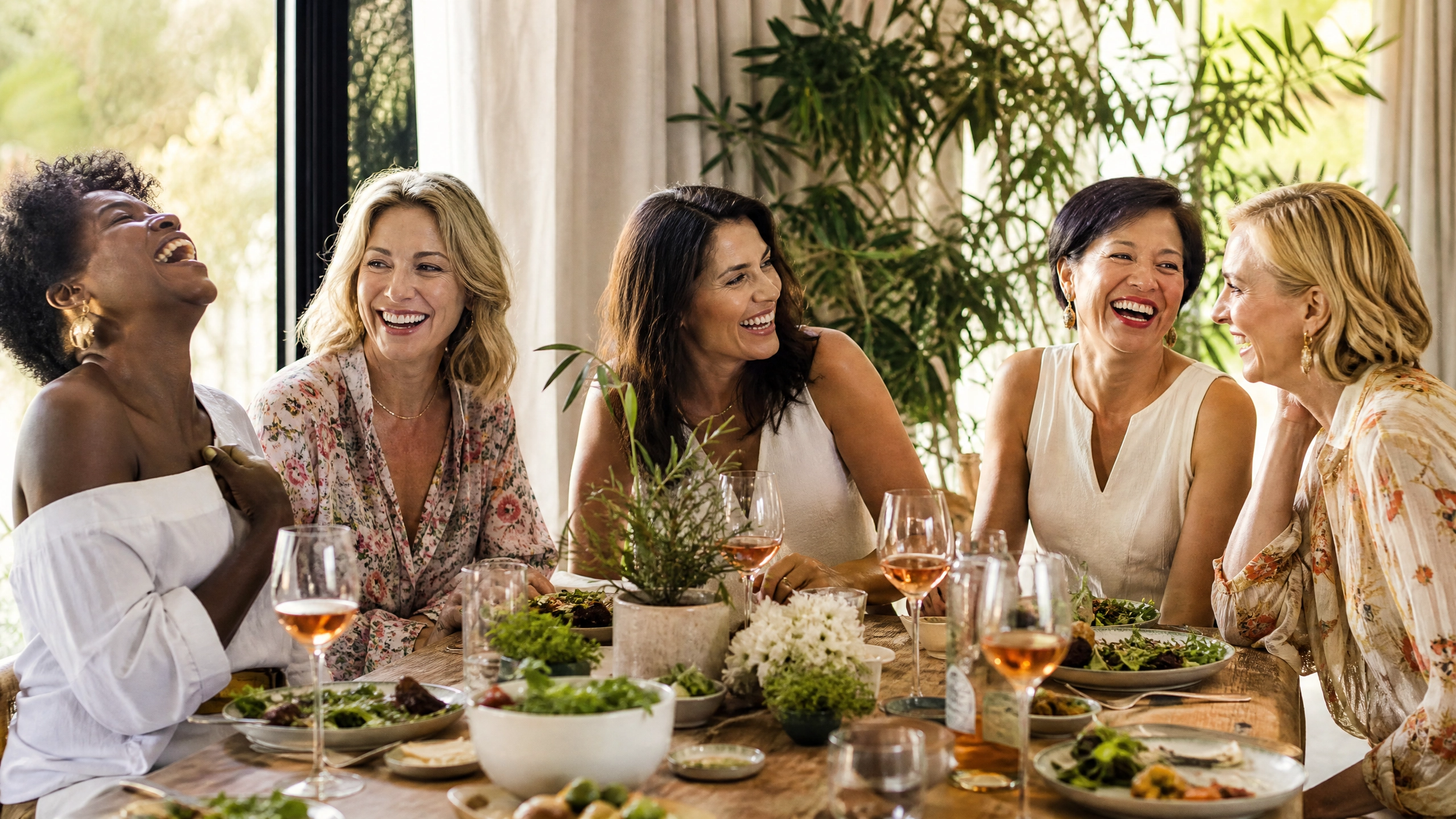
Last weekend I had one of those days you want to bottle. Spa, long lunch, five women around a table — the kind of gathering where the conversation never quite lands back where it started because someone always pulls it somewhere better.
I'm new to the group. And I felt it.
The women were funny. Genuinely funny, not performatively funny. Warm, accomplished, the kind of grounded that takes decades to develop. And every single one of them was mid-sentence in a story they hadn't finished yet.
Between the five of us, there was: a relationship being quietly interrogated — not because anything was wrong with it, but because the more honest question was whether any relationship was wanted right now. A career that looked perfect on paper but had started to feel like someone else's idea. A creative life overflowing with capability but short on clarity about what to actually do with it. A workplace situation requiring patience that was being found, barely, one day at a time. And the particular weight of watching someone you love navigate something difficult, while still showing up and laughing loudly enough to turn heads.
Nobody was falling apart. Nobody needed rescuing. They were just — honestly, refreshingly — telling the truth about where they actually are.
And then there's me. I don't have children. I left a career sixteen years ago and now I — well….. I google. I cook. I occasionally write a blog post. Oh, and I'm building something. I think.
That was the loop running quietly in my head as I sat around that table thinking: do I cut the mustard here?
Which is, I appreciate, completely absurd.
Because if any one of those women had leaned over and whispered I'm not sure I belong here —I would have looked at them like they'd lost the plot. We always extend the grace to others that we can't quite locate for ourselves.
Here's what nobody tells you about rooms full of remarkable people: everyone in them is doing their own version of the same quiet calculation. Are my contributions significant enough? Is what I'm carrying heavy enough, or interesting enough, or resolved enough to warrant a seat at this table?
The answer, for the record, is that the question itself is the problem.
I've been thinking a lot lately about that particular tension — the gap between the life you've built and the woman you've become. It's something I write about, talk about, have built an entire platform around. And yet I sat in at that table, surrounded by women navigating exactly that territory, and managed to wonder if I was enough.
Not in a crisis way. Just in a very human, very ordinary, slightly annoying way.
What I left with — apart from a very good lunch — was this: not one of those women had it sorted. Not one of them was finished becoming whoever they're becoming. They were all somewhere in the middle, same as me, just further along in different directions.
That's not a consolation prize. That's actually the whole point.
And here's what I keep coming back to. Those conversations — the honest ones, the ones where someone says the thing they haven't quite said out loud before — didn't happen in spite of the meal. They happened because of it. The long lunch, the unhurried table, the food arriving in stages and nobody rushing anywhere. There's something about sharing a meal that slows you down just enough to tell the truth.
We talk about food as fuel. As the thing we should probably be doing better. As nutrition, as protein targets, as whatever we read last week that made us feel vaguely guilty.
But sometimes the most important thing a meal does is create the conditions for a conversation that needed to happen.
Food isn't incidental to how women feel and function and connect at this life stage. It's structural.
Here's what I mean by that. Estrogen and progesterone are not just reproductive hormones — they're deeply involved in how your brain produces and regulates serotonin and dopamine. The chemicals that underpin mood, motivation, memory, and the capacity to think clearly. When they shift, as they do in perimenopause and beyond, everything shifts with them. The anxiety that appears from nowhere. The 3am waking. The feeling that you've lost access to a version of yourself you used to trust.
What you eat is part of that story. Not in a fix-yourself, clean-eating, follow-this-plan way. But in the very unglamorous, well-researched sense that your brain needs specific things to function — and that when you get that right, you get a bit more of yourself back. More clarity. More steadiness. More capacity to sit at a table with remarkable women and actually be present for the conversation, rather than running a quiet internal audit of whether you deserve to be there.
And if you're sitting at a table with women who are funny and honest and mid-sentence in their own stories — the right question is probably less do I belong here and more what do I actually want to say?
I didn't say any of it, as it turns out. I smiled, I laughed, I had a very good lunch. I came home slightly undone in the best possible way, and I did what I do: I googled things, I thought about food, and I wrote it down.
So this is me saying it now. To them, and to anyone else who's ever sat in a room full of remarkable women and quietly wondered if they measured up.
You're in good company. And your brain — for reasons we will talk about in an upcoming Journal edition — will thank you for it.
